The Parenting Lesson I Didn’t Learn From My Doctorate
How grief, motherhood, divorce, a second chance at love—and a bowl of buffalo dip—changed everything I thought I knew about raising kids.
I’ve spent my career studying children’s brains.
But some of the most important things I’ve learned about mental health didn’t happen in a classroom, a clinic, or a research study.
They happened in my own home.
Long before Raising Brains® was a book, a framework, or something we were bringing into schools, it started with my family.
And my family was…a lot.
Growing up, my youngest sister developed a chronic pain disorder after an injury. My middle sister was growing up with Asperger’s, although we didn’t know that at the time.
And there were three girls in our house.
So our house was a storm.
Yelling. Crying. Fighting. Loving. Emoting.
So. Much. Emoting.
If emotional regulation had been an Olympic sport, we would not have medaled.
Then my mom got colorectal cancer.
At almost exactly the same time, I found out I needed surgery to remove a cyst from my ovary.
My aunt was—and still is—the best GYN surgeon we knew, so my mom and I flew to Seattle together. I would have surgery, and my mom would get a second opinion about her cancer.
I remember sitting in a room while the doctors talked about my mom.
And then I couldn’t sit there anymore.
I got up and walked out into the hallway.
I can still picture myself walking those halls because I simply couldn’t listen to people talk about my mom having cancer.
At the time, I thought I was just walking.
Now I understand something I didn’t understand then:
That was behavior.
My body knew I had reached my emotional limit before I consciously did.
I couldn’t say, This is too much. I’m overwhelmed. I need to regulate.
So my body said it for me.
It got up.
It walked.
It got me out of the room.
There are moments when your brain simply says, Nope. We are full.
That was one of them.
We flew home to New Jersey.
I went back to college.
I took my mom to cancer treatments.
At night, I distinctly remember opening my bedroom window—an actual, physical window—because I felt like there was so much emotion inside of me that I needed somewhere for it to go.
I needed to let some of it out so I could breathe.
At the same time, I was visiting my sister in the hospital while she went through test after test after test, eventually finding a treatment that helped her become more functional.
And then, for a little while, everyone was okay.
My mom got better.
My sister got better.
I got married.
I tried to have babies.
And then I lost one.
And then I lost two more.
Three babies in two years.
Jake. Then Alex. Then Owen.
Each of them lived for only about an hour.
There isn’t a clever sentence that makes that part easier to write.
They were my babies. Now they weren’t. And then I had to figure out how to keep going down a path I hadn’t planned for myself.
Each time, I picked myself up and went back to work.
After the first loss, I was back within two weeks.
After another, it took a little longer because I had lost so much blood that I needed a transfusion and was anemic.
I don’t tell you that because I think going back to work made me strong.
Looking back, I’m not even sure it was the healthiest thing to do.
It was simply what I knew how to do.
Keep going.
And eventually, I had two beautiful children.
I felt so incredibly lucky.
Life settled down.
For a minute.
Because apparently my family did not subscribe to the boring years package.
A few years later, my mom got breast cancer.
I remember exactly where I was when we found out.
I was away in the Poconos with my kids, and we were playing games.
I cried.
My kids hugged me.
I hugged them.
And then, together, we watched Mimi get better.
But within that same year, my marriage was falling apart.
My then-husband quit his job one day. Literally walked out.
This happened right after I had taken a huge pay cut to become a professor and start my own business helping children and families and working with schools.
The financial pressure was enormous.
The emotional pressure was enormous.
And then my sister was diagnosed with breast cancer.
She was 28.
I remember my dad saying something I will never forget:
“We went from wishing our daughter didn’t have to get a mastectomy and chemo to wishing our daughter only had to get a mastectomy and chemo.”
That change happened in a matter of days.
Suddenly, we weren’t talking about getting through treatment.
We were talking about losing her.
At the same time, my marriage was crumbling.
One day, my sister and I were sitting together after her chemo, having a couple of drinks and doing our best to pretend none of this was actually happening.
Because sometimes denial pairs nicely with a cocktail.
She started yelling at me about my marriage.
She wanted me to do something.
And I remember looking at her and saying:
“You have to die first.”
It sounds horrible when I write it.
But she understood exactly what I meant.
The brain only has so much capacity to process emotion, and mine was completely full.
I couldn’t grieve my marriage while I was trying to comprehend losing my sister.
I didn’t have room for another catastrophe.
So I told her she had to die first.
And then she did.
She was 29.
My kids watched all of it.
They watched their Mimi fight cancer.
They watched their aunt get sicker.
They watched me lose my sister.
They watched their parents’ marriage fall apart.
And mostly, they watched me.
Not some polished version of me.
Not the pediatric neuropsychologist who knew all the right things to say about emotional regulation.
Me.
And I did not always look particularly regulated.
Death doesn’t necessarily bring out the best in people.
There were fights in my family. There was anger. Grief. Exhaustion. Hurt. All of the ugliness that sometimes spills out when a group of people love the same person and are completely devastated.
And again, I understand those fights differently now.
They were behavior.
Just like walking those hospital hallways had been behavior.
Just like opening that window had been behavior.
There was emotion underneath all of it.
We just weren’t always very good at identifying it before it came out sideways.
After one of those fights, I was sitting on the floor crying.
My son Carter walked in.
He looked at me.
“Mommy, you’re so sad.”
Then he hugged me.
After a minute, he said:
“I know what will help. I’ll get Aunt Mamy.”
He couldn’t say Amy yet, so my best friend Amy was “Mamy.”
Carter went and got her.
Amy thanked him, came into the room, picked me up off the floor and—like any good best friend—offered to fight all of them for me.
And then...
we made buffalo dip.
And we got the kids dinner.
Because apparently grief, emotional regulation, and buffalo chicken dip can coexist.
I think about that moment all the time.
Because that was mental health education.
I just didn’t know it yet.
My kids were watching.
They watched me cry.
They watched me completely fall apart.
They watched me let someone see me fall apart.
They watched me accept help.
And then they watched me get up off the floor and make dinner.
I wasn’t teaching them that strong people don’t cry.
I was teaching them what you can do after you cry.
They were learning that horrible feelings can feel enormous without lasting forever.
That you can be absolutely devastated and still take the next step.
That sometimes the next step is meaningful and profound.
And sometimes the next step is buffalo dip.
Both count.
They also watched us take some of our grief and put it somewhere.
That year, with the help of our incredible family and friends, we raised more than $100,000 for St. Jude Children’s Research Hospital.
My kids watched pain become purpose.
They were learning how to cope.
How to adapt.
How to ask for help.
How to keep going.
Then I got divorced.
I moved with my kids to a new town.
They started over at a new school.
Six months later, the entire world shut down.
COVID.
At that point, I think even my kids had every right to look at me and say, Seriously? What now?
But that was when I saw something that changed the direction of my work.
My kids didn’t crumble.
That doesn’t mean COVID was easy for them.
It wasn’t.
It doesn’t mean they never got sad, frustrated, lonely, angry, or overwhelmed.
Trust me.
They did.
My kids have always been pretty out loud and proud with their feelings.
When they were experiencing something, generally speaking, the rest of us were also going to be experiencing it.
Sometimes at volume.
It didn’t always come out the right way.
Sometimes it was yelling.
Sometimes crying.
Sometimes stomping.
Sometimes an attitude that made you wonder whether your sweet child had been temporarily replaced by someone who found your very existence offensive.
But it was out.
And over time, I came to realize that was actually a gift.
Because behavior gave me somewhere to look.
It was a clue.
Something is happening here.
For other kids, emotion doesn’t look like that at all.
It gets quiet.
They push it down.
They comply.
They smile.
They say, “I’m fine.”
Sometimes they are the kids everyone thinks are doing beautifully.
Until the emotion has been buried so deeply that the only evidence we get is something that seems completely unrelated.
They stop doing their homework.
They start avoiding school.
They can’t sleep.
They snap at someone over something tiny.
They procrastinate.
They shut down.
They make a choice that seems to come out of nowhere.
And adults look at the behavior and ask:
Why would you do that?
But whether emotion comes out loud and proud or whispers through behavior we almost miss, the behavior gives us a trail back to what’s happening underneath.
That became enormously important to me.
Because behavior isn’t just something children do to us.
It tells us something.
Sometimes it tells us something before the child even knows what they’re feeling.
Just like my feet told me when I needed to leave that hospital room years before I had the language to explain why.
Behavior can lead us back to emotion.
And emotion can lead us back to the brain.
During COVID, I could see that my kids had learned how to follow that trail.
They knew how to cope.
They knew how to adapt.
They knew that plans change.
They knew how to ask for help.
They knew that big feelings eventually get smaller.
They knew they could feel something without immediately having to make it disappear.
They knew how to work with their emotions instead of always being controlled by them.
And while I was watching my own children cope, I was also watching the children and families I worked with struggle in ways I had never seen before.
I started noticing the difference.
And suddenly, my personal life and my professional life collided.
I’m a pediatric neuropsychologist.
I understand what happens in a child’s brain when emotions get big. I understand executive functioning, inhibition, flexibility, emotional regulation, attention, problem solving, and decision making.
I had spent years studying these things.
But now I was watching them happen in real life.
And I realized something that became the foundation for everything I do today:
It’s not that things weren’t tough.
It’s that my kids had the skills to be tough.
And then life gave me another classroom.
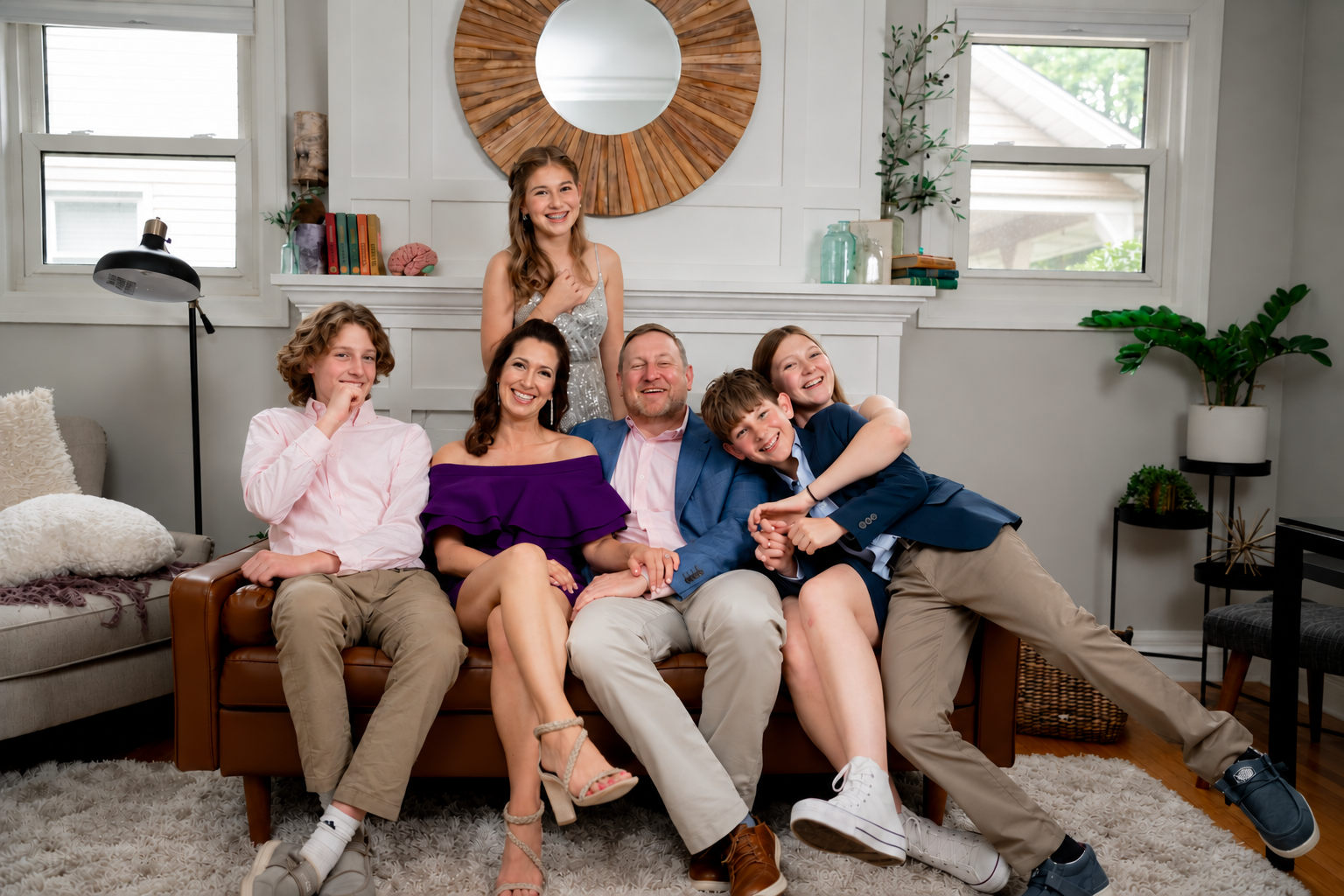
I started dating Kevin.
Eventually, we got married and began blending our families.
And if you ever want to become humble about your expertise in parenting, I highly recommend blending a family.
Suddenly, there were different kids, different histories, different personalities, different expectations—and two adults who had both successfully raised children without, shockingly, doing everything exactly the same way.
As a person who had spent her career thinking about children and families, this was incredibly enlightening.
And occasionally annoying.
Because I had to confront something important:
There isn’t one “right” way to parent.
Two parents can handle the same situation completely differently and still raise kind, capable, emotionally healthy kids.
Different styles can lead to the same outcome.
But I started to see that underneath the styles were some core beliefs that mattered much more than whether we agreed on every parenting decision.
Love.
Kids need to know, unquestionably, that they are loved.
Trying.
I have come to believe deeply that it is the trying that makes you a good parent.
Not getting it right every time.
Not being endlessly patient.
Not regulating yourself beautifully while your teenager explains why the completely reasonable thing you just asked them to do is actually a violation of their human rights.
Trying.
Coming back.
Repairing.
Learning.
Trying again.
Support and reflection.
Helping kids look at their own experiences without judgment.
How did that feel for you?
Did you like how you reacted?
Did that get you what you wanted?
Would you want to handle it differently next time?
Not telling them how they should feel.
Helping them understand how they do feel.
Because reflection is how experience becomes learning.
Lifting kids up instead of removing everything in their way.
There is a difference between supporting a child and solving everything for them.
Sometimes love means fixing something.
And sometimes love means standing close enough that they know you’re there while they figure out how to stand on their own two feet.
That one can be brutal as a parent.
We want to rescue them.
We want to make the call.
Email the teacher.
Fix the friendship.
Solve the problem.
Remove the discomfort.
Preferably by 4:00.
But every time we appropriately let a child struggle, think, choose, recover, and try again, we are helping build the person who will someday have to do those things when we aren’t standing next to them.
And finally:
Emotion. Real emotion.
Our children don’t need parents who never lose it.
Thank God, because I would have been disqualified years ago.
They need to see what human beings do with emotion.
Sometimes we regulate beautifully.
Sometimes we don’t.
Sometimes we pause and take a breath.
Sometimes we yell and later say, I really didn't like the way I handled that.
Sometimes we cry on the floor.
And sometimes we get up, call Aunt Mamy, make buffalo dip, and try again tomorrow.
That is part of the lesson too.
Because life is full of hard things.
Friendships end.
People get sick.
Plans fall apart.
Kids fail.
They get rejected.
They get embarrassed.
They get their hearts broken.
They make mistakes.
People they love die.
We cannot save our kids from all of it.
And I’m not sure we should try.
What we can do is make sure the first time they need coping skills isn’t in the middle of a crisis.
We can build the foundation first.
We can teach a child how to notice what’s happening inside their body.
How to sit with discomfort.
How to ask for help.
How to pause.
How to problem solve.
How to shift when Plan A falls apart.
How to survive disappointment without believing their life is ruined.
How to make a decision when every emotion in their body is screaming:
DO SOMETHING RIGHT NOW.
Because this is the part of mental health prevention I don’t think we talk about enough:
Mental health skills are decision-making skills.
Think about being a teenager for a second.
Your friend stops talking to you.
Someone breaks your heart.
You fail something you thought you were good at.
You’re humiliated.
You’re angry.
You’re lonely.
You’re scared.
And your brain still has to answer one very important question:
What do I do next?
That’s the moment I care about.
Because a child who can tolerate discomfort has more options than a child who needs the discomfort to stop right now.
A child who can pause has more options.
A child who can ask for help has more options.
A child who can recognize, The thing I'm doing right now is telling me something is going on inside of me, has more options.
A child who knows, I have felt horrible before and I survived it, has more options.
And sometimes those options matter enormously.
We spend so much time intervening after kids are struggling.
After the behavior.
After the bad decision.
After the crisis.
I want us to get there sooner.
I want us to look at behavior differently.
Not:
How do we stop this behavior?
But:
What is this behavior telling us?
What is happening in this child’s brain?
What skill is missing in this moment?
And what can we teach or support so that next time, this child has another option?
That is why the phrase that has come to define my work means so much to me:
Behavior is the end, not the beginning.™
Behavior is often the thing we notice first, but it’s the end of the process.
Underneath it is a brain that has been processing an experience.
An emotion.
A demand.
A fear.
A disappointment.
A skill the child may not have yet.
Sometimes behavior screams.
Sometimes it whispers.
Sometimes it looks like a child melting down in the middle of the kitchen.
And sometimes it looks like a college-aged girl silently getting up from a chair and walking the hallways of a hospital because her brain cannot listen to one more word about her mom having cancer.
I didn’t know it then.
But my behavior was telling the story.
And our kids’ behavior tells us stories every day.
We just have to learn how to read them.
That’s why I wrote the first Raising Brains book.
It was never supposed to be just a book.
It was my attempt to put into words what I had lived, what I was seeing clinically, what raising my own kids had taught me, what blending a family taught me, and what I knew about the brain:
We cannot make life easy for our kids.
But we can give them the skills to get through hard things.
That little idea became something much bigger than I ever imagined.
It became Raising Brains®.
Then Brainy Tales.
Then classrooms.
Teachers.
Parents.
Schools.
Professional development.
Research.
And thousands of conversations about looking beyond a child’s behavior and asking a different question:
What skill does this child need us to build?
And now, that movement has reached another milestone.
We’re celebrating the release of Raising Brains for Teachers and its companion Raising Brains for Teachers Workbook.
I’ll tell you much more about those soon.
Because today, this isn’t really a book announcement.
I wanted you to know why the books exist in the first place.
They exist because once upon a time, a little boy found his mom crying on the floor.
He noticed.
He hugged her.
He figured out who could help.
And then he watched her get back up.
At the time, I thought I was just trying to survive a terrible day and feed my kids dinner.
Years later, I realized Carter had been learning something in that moment that no worksheet could ever teach him.
He was learning:
Hard things happen.
People fall apart sometimes.
We ask for help.
We figure out what our feelings are trying to tell us.
We take the next step.
And eventually, we get back up.
Our job isn’t to make sure our children never fall.
It’s to build the skills that help them know what to do when they do.
That’s the mental health foundation I want for every child.
That’s the movement we’re building.
And that’s why I do this work.
With love,
Dr. Sarah
Behavior is the end, not the beginning.™
Raising Brains®
Building skills for the moments that matter most.